| There are two types of set squares and they are named according to the
angles present on each.
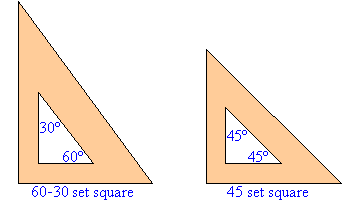
Set squares are useful for drawing parallel lines and perpendicular lines.
Parallel Lines
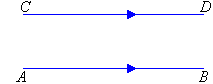
Lines that lie in the same plane and do not meet one another are said to
be parallel lines.
In the accompanying diagram, the line AB is parallel to the line CD. This is indicated by the similar arrows.

Drawing Parallel Lines
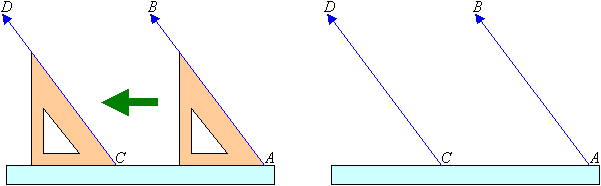
A ruler and set square can be used to draw parallel lines as described
below.
Step 1: Position an edge of the set square against a ruler
and draw a line along one of the other edges.
Step 2: Slide the set square into a new position while keeping
the ruler fixed exactly at the same position.
Step 3: Draw a line along the same edge that was used in Step
1.

Example 17
Use a ruler and set square to draw a line that is parallel to a given
line, AB, and passes through a given point, P.
Solution:
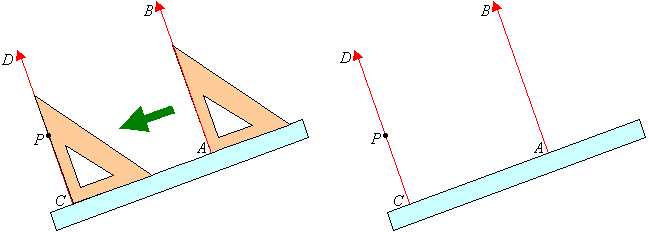
Step 1: Position an edge of the set square along the given
line, AB.
Step 2: Place a ruler against one of the other edges.
Step 3: Slide the set square along the ruler until the edge
used in Step 1 passes through the given point P.
Step 4: Draw the line CD through P.
The line CD passes through the given point, P, and is
parallel to the given line AB.
Perpendicular Lines
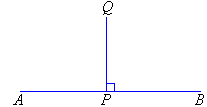
Lines that are at right angles to each other are said to be perpendicular
lines.
Note that a vertical line is perpendicular to the horizontal,
whereas perpendicular lines can be drawn in any position.
Bricklayers use a plumb-bob to set out vertical lines and a spirit level to
set out horizontal lines.

Drawing Perpendicular Lines
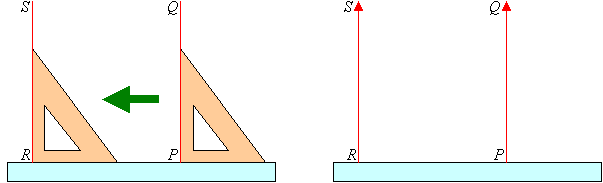
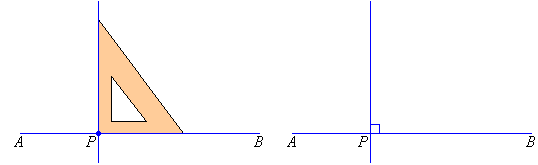
A set square can be used to draw a perpendicular at a point on a given
line as described below.
Step 1: Set an edge of the set square on the given line so
that the other edge is just in contact with the point.
Step 2: Draw a line that passes through the given point with
the help of the set square.
Example 18
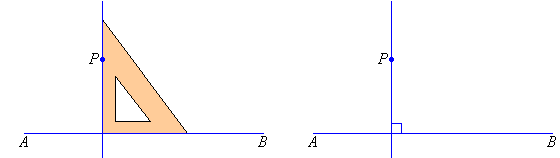
Use a set square to draw a perpendicular to a given line, AB,
through a point, P, not on the line.
Solution:
Step 1: Set an edge of the set square on the given line so
that the other edge is just in contact with the point.
Step 2: Draw a line that passes through the given point with
the help of the set square.
Key Terms
set square, parallel lines, perpendicular
lines, right angle |