

G S Rehill's Interactive Maths Software Series - "Building a Strong Foundation in Mathematics" from mathsteacher.com.au.

Order Maths Software for $25


Year 9 Interactive Maths - Second Edition


Linear Equations

Linear equations are also called first degree equations, as the highest power of the variable in these equations is 1.

E.g. x + 5 = 9 is an equation of the first degree, which is often called a linear equation.


Solving Equations

Recall that:

To solve a linear equation, we do the same operation to both sides of the equation.  This means we can:

  • Add the same number to both sides of the equation
  • Subtract the same number from both sides of the equation
  • Multiply both sides of the equation by the same number
  • Divide both sides of the equation by the same number


Equations Involving One Operation

In this section, we will consider equations involving addition, subtraction, multiplication and division.


Equations Involving Addition

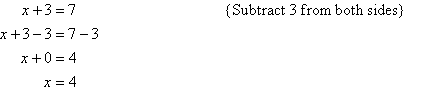
Remember that we can subtract the same number from both sides of the equation.

Example 1

Solve x + 3 = 7 for x.

Solution:


Problem Solving

To solve problems, we use the following approach.

Read the problem carefully.  Assume that the unknown number is x (or another suitable pronumeral).  Use the data given in the problem to write an equation.  Then solve the equation for x, and state the answer in words.

Example 2

If a number is increased by 8, the result is 25.  Find the number.

Solution:

Let x be the number.

Increasing x by 8 gives x + 8, which we are told is 25.

So, the number is 17.


Key Terms

linear equations, first degree equations, operation


Study Another Topic in Chapter 2: Linear Equations and Inequalities

[ Linear Equations ] Equations Involving Subtraction ] Equations Involving Multiplication ] Equations Involving Division ] Equations Involving Two or More Operations ] Equations Containing Brackets ] Equations Containing Fractions ] Linear Inequalities ] Adding a Number to Each Side of an Inequality ] Multiplying Each Side of an Inequality by a Positive Number ] Dividing Each Side of an Inequality by a Positive Number ] Multiplying Each Side of an Inequality by a Negative Number ] Dividing Each Side of an Inequality by a Negative Number ] Further Inequalities ] Inequalities Containing Brackets ] Inequalities Containing Fractions ] Formulas ] Rearrangement of Formulas ] Transpositions Involving Subtraction ] Transpositions Involving Division ] Transpositions Involving Multiplication ] Further Transpositions ] Transpositions Involving Brackets ] Transpositions Involving Fractions ] Problem Solving ] Problem Solving Unit ] Symbols ] Index ]


Study Another Chapter
 

| Home Page | Order Maths Software | About the Series | Maths Software Tutorials

| Year 7 Maths Software | Year 8 Maths Software | Year 9 Maths Software |

| Year 10 Maths Software | Homework Software | Desktop Schools |

| Laptop Schools | Tutor Software | Maths Software Platform | Trial Maths Software |

| Feedback | Year 7 Maths Reading | Year 8 Maths Reading |

| Year 9 Maths Reading | Year 10 Maths Reading | About mathsteacher.com.au |

| Our Policies | Terms and Conditions | Links | Contact |


The following international Websites are available for faster software downloads:
www.mathssoftware.co.nz for New Zealand, www.mathsoftware.biz for the USA,
www.mathematicssoftware.co.uk for the UK, www.mathssoftware.co.za for South Africa
and www.mathsoftware.in for India.


Copyright © 2000-2012 mathsteacher.com Pty Ltd.  All rights reserved.

Australian Business Number 53 056 217 611


Copyright instructions for educational institutions


Please read the Terms and Conditions of Use of this Website and our Privacy and Other Policies.

If you experience difficulties when using this Website, tell us through the feedback form or by
phoning one of our contact telephone numbers.