|
John Napier, a Scottish baron, introduced the decimal number system
in 1619 A.D. The decimal number system is easier to use in everyday life
than fractions as it is a base 10 system.
Decimal numbers are commonly used in areas such as finance, medicine and
construction when measuring units such as currency, mass and distance.
It is useful to know decimals thoroughly, as they are involved in many
aspects of daily life.
Place Value
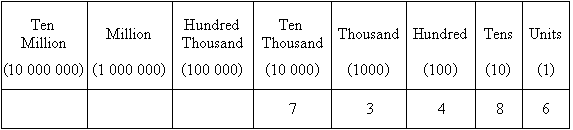
Recall that a whole number such as 73 486 has 5 digits and the place value
table for the whole number is as follows:

-
- In expanded fractional form, 72.649 is written as:
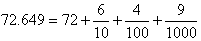
- So, 72.649 has seven tens, two units, six tenths, four hundredths and
nine thousandths.
-
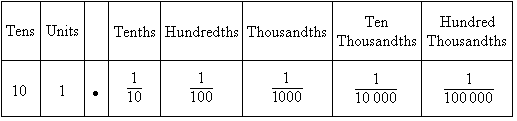
We find from the place value table of 72.649 that:
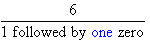
- The digit 6 is in the first place after
the decimal point. So, it represents:

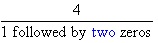
- The digit 4 is in the second place after
the decimal point. So, it represents:

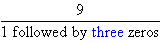
- The digit 9 is in the third place after
the decimal point. So, it represents:

In general:
- To express the decimal place value of a number in fractional form, the
position of the digit in the number tells us how many zeros are
to be added after the 1 in the denominator.
-
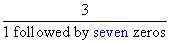
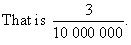
- For example, 3 in the decimal number 94.19547632 is in the 7th
place after the decimal point. So, it represents:
Example 1
Give the place value of 8 in the following decimal numbers:
a. 0.856
b. 0.384
c. 0.4386
d. 0.16982
Solution:




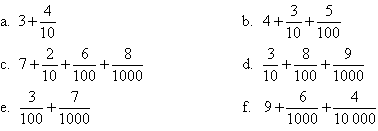
Example 2
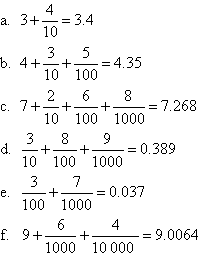
Write each of the following as a decimal number:
Solution:
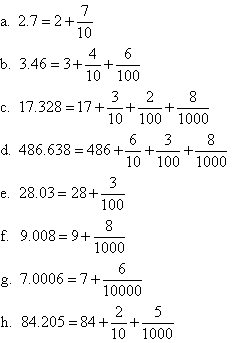
Example 3
Write each of the following numbers in expanded
fractional form:

Solution:
Example 4
Write each of the following decimal numbers in words:

Solution:
a. 7.3 represents seven units and three tenths.
b. 84.6 represents eight tens, four units and six tenths.
c. 3.189 represents three units, one tenth, eight hundredths and nine
thousandths.
d. 18.3478 represents one ten, eight units, three tenths, four hundredths,
seven thousandths and eight ten-thousandths.
e. 0.008 represents eight thousandths.
f. 0.000 043 represents four hundred-thousandths and three millionths.
Key Terms
decimal number, decimal number
system, place value table, place
value, expanded fractional form
|